April 13, 2022

My Sci-Fi, Fantasy & Horror Short Fiction Roundup - March 2022


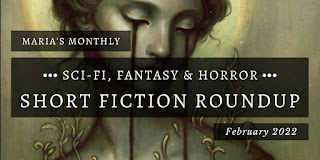
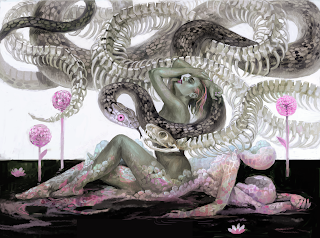
The art for this roundup includes a detail of the cover for Fantasy Magazine #77. Cover art by Анна Богатырева / Adobe Stock.

An audio version of this roundup is available on YouTube:


🕮 

The Angel Azrael Encounters the Revelation Pilgrims and Other Curiosities by Peter Darbyshire in Beneath Ceaseless Skies

The angel Azrael rode across the badlands on the dead horse for so many days and nights that he became lost, until a dying woman’s bloody bible set him on a path back to the world.

An absolutely wild and captivating weird west tale, Darbyshire's story involves angels walking the earth after some kind of devastating apocalyptic event that has laid waste to much of mankind. There are also nephilim about, we encounter zombies and terrifying gargoyles, and there are bibles of various kinds that are sources of power and magic. At the beginning of the story, the angel Azrael is entrusted with a powerful book of a different kind from a dying woman and he promises to bring it to her daughter in a place called Jerusalem's Sorrow. What happens after that is an angelic/diabolical western tale of deception and strife that had me hooked from beginning to end. Brilliant worldbuilding and characters.

A Nickel For The Burlap Man by Patty Templeton in Beneath Ceaseless Skies

This is folklore-horror-fantasy of the very best kind. In a tense and taut tale studded with shards of violence and darkness, Templeton lays out the chilling backstory to what is introduced in the story's first paragraph:

 If you walk west of town and into the woods there’s a scarecrow. A steward of the forest instead of the field. He’s nailed to repurposed railroad ties. The cross obstructs a cart-sized hole in a cottonwood tree. The scarecrow is a cadaver wrapped in potato sacks. His exposed hands are leathered. Critters’ve nibbled fingers to pointed bone. Bit through boot, sock, and honed his toes. The face is not a face. It’s a middle-meeting seam gracelessly sewn. He has no hat.

A masterclass in folk-horror that packs an emotional punch.

🕮

Becomes the Color by E. Catherine Tobler in Three-Lobed Burning Eye

“Muscle, bone, and marrow dissolved, deepened the turquoise, and created the darker depths, where the blue went black.” 

A hauntingly, eerily beautiful story about a very strange lake with an ominous and mysterious history. When the narrator goes back to the lake, and a nearby cabin, after many years away, the ghosts of the past are present everywhere. Near the water, even the landscape seems nightmarish or dreamlike as night comes. I love the way Tobler gives us a sense of a larger world, and a life lived, beyond the edges of the story, and I love how the darkness (and the mystery) deepens with every line and paragraph.

Oak moss and Ambergris by Joe Koch in Three-Lobed Burning Eye

This story is filled with heady scents and beguiling perfumes, and it's set in a future where there is an interplanetary smuggling business involving various rare and expensive compounds that are valued specifically for their scent. Laden, the protagonist, has been working as a mule, smuggling such substances inside their body, for years, but the work has changed them (and has taken a toll) in more ways than one. This is an emotionally and erotically charged story of love and desire, greed and lust and transformation. It's science fiction with a carnal, hungry vibe and I adore every bit of it.

🕮

Ribbons by Natalia Theodoridou in Uncanny Magazine

Monday’s lover tugs at Jan’s ribbon with his teeth. Jan doesn’t yell at the lover to stop. The guy just received bad news from the front—a friend lost to a bomb, perhaps, a sibling blown to bits; Jan doesn’t ask. He tells the lover, instead, to be careful: We don’t want my head rolling off now, do we? We’ve all heard of them, after all, the stories of women taking it off and their heads falling to the ground.

If you're looking for a story to tenderly, gently, yet fiercely undo your heart and soul, then this story by Theodoridou is the perfect thing. Jan lives in a world of war and strife, trying to find a way to live with the grief and sorrow and longing that permeates his life. Jan also wonders about the ribbon around his neck, about those he meets that wear no ribbons, wondering what that would be like. There is love and caring in this story, violence and fear too, sex and desire as well, gender and identity, but what gets me the most is the gentleness beneath it all.

🕮

Seven Times Seven by A.C. Wise in Kaleidotrope

They are going to have to look. They are going to have to face the thing in the trunk and know for sure what it is they brought out of the woods. The dreams could merely be memories. They could. But they don’t know for sure.

(They know. They do not want to know, but they do.)

A twisted, twisting, harrowing tale of Jax who is in a car with a timer on the seat and a creature (maybe) in the trunk and the memories of their friend and lover Marcus running through their head. Jax is trying to get everything they want, but what they have to do to get it, what they have already done (maybe?), could also be their undoing. I love how reality is changeable and slippery here, as Wise lets memory and fear and hope weave together in Jax's mind. Whatever Jax brought out of the woods, whatever they left behind, nothing is certain in this tale except Jax's desperation and pain.

🕮

Hush by Mary Anne Mohanraj at TOR.com

A subtle, quiet science fiction story about violence and bigotry and about the small, everyday choices we can make in order to reduce the evil of the world, even if it's just in some small, flawed way. The story is about Jenny, who returns to her home planet in the midst of widespread and ominous civil unrest. There are anti-alien protests, and a stay-at-home-order, and all Jenny wants to do is go home. However, her homecoming is made more complicated when she has to escort her neighbor Katika, an alien Razuli girl, home safely.

🕮

Nine Tails of a Soap Empire by Maria Dong in Lightspeed

I’ve never told him about the coal I swallowed three years ago, the way it has plagued me ever since. Some nights, when I’m trying to sleep, it burns like the feathers of the vermilion firebird, five-colored fury that threatens to turn me to ash. Other times, it is barely the faint warmth of a finger on a wrist, a flutter that could be drowned out by the pulse of a thumb.

But the coal is always lit. I am always hungry.

This is a fantastic fantasy tale about a very ambitious, magically inclined, soap-maker with grand dreams of establishing an empire, and what happens when they receive a summons from the Maripgan. The journey to the Maripgan is not easy, and on the way there, the soap-maker is haunted, and maybe hunted, by a mysterious fox. I love the fairytale texture of this story, and I absolutely LOVE the ending.

The Heaven That They Never Knew by Merc Fenn Wolfmoor in Lightspeed

Ginger clings to the skin of Heaven, wrapped in deep, cold vacuum. She’s a speck in the void and her breath trembles inside her helmet. No sound in space. So she breathes. She has to stay grounded, keep her thoughts from shaking and drifting to hostile sensors.

A scifi epic in flash fiction format, where Ginger, humanity's only hope to survive, approaches Heaven, the terrifying alien construct that devours and destroys life anywhere and everywhere. Tense, taut, and with a lyrical space beauty, Wolfmoor's story is like a song at the edge of space.

🕮

Christopher Mills, Return to Sender by Isabel J. Kim in Fantasy Magazine

This is the dead thing becoming the body. This is the dead thing opening the body’s eyes. This is the dead thing rising from the grave. This is the dead thing saying “What the hell—I didn’t ask to be summoned. I was having a great time being dead and dreaming about nothing.”

Oh how I love this gritty, growly, sweary story of necromancy, death, revenge, and with a complex and complicated sibling relationship at its heart. It's set in a world where necromancy is an accepted and rather normal part of life (with necromancers working office hours), and where the testimony of the dead can be used in legal proceedings. All of this is the setup for a fabulous tale where a sister resurrects her brother in order to solve his murder. This story is both dark, painful, and funny and I could not put it down once I started reading.

🕮

Emmory and the Wolf by Lowry Poletti in LampLight Volume 10 Issue 3

The wolf wakes beside a corpse she doesn't recognize. When she stands, she realizes her paws have been replaced with hands scraped raw by the asphalt, and she cries.

I do love wolf and werewolf stories, and this one is both powerful and devastating. A woman who is/was a wolf has made a domestic life with her partner with a home and children. The wolf still calls to her, and the change still happens when the moon is right, but she insists she wants the life she's made away from the woods, away from the wolves. Poletti unravels the domestic peace bit by bit in this story, digging into the unhappiness and darkness beneath with sharp claws, and the ending hit me like a ton of bricks.  

🕮

Them At Number Seventy-Four by Lindz McLeod at PseudoPod (narrated by Katherine Inskip)

When body number four is discovered, Mrs Patterson thinks that surely now she and her husband will be caught. Days creep past, then a week. 

Two. 

Three.

Their excitement and relief begins to fade.

A marital murder tale, this story really resembles nothing else I've read recently. We follow an old married couple as they go about their daily regular lives in retirement (TV shows, food, shopping, gardening). There seems to be nothing really notable about them, except that they murder people, together, as a couple's activity. McLeod tells this story with such quiet, detailed focus, and it makes the story chilling, darkly humorous, and devastating on a number of levels. This one will stick with me for a while, and I think one terrifying aspect of it is how McLeod shows us two people who seem like regular everyday humans on the outside, but who also do not see others as human in the same way they are. It's a fascinating story and also, Katherine Inskip's narration is pitch-perfect.

🕮

The Assembly of Graves by Rob E. Boley in Diabolical Plots

From the bathroom, a dripping noise. It doesn’t sound like a leaky faucet though. No, it’s heavier somehow. More ominous. Naomi stares a moment into the flickering, throbbing darkness.

My favourite kind of haunting tale, this one involves a hotel getaway for Naomi and her wife Jeanne. Naomi feels like Jeanne is slipping away from her, and she is trying to reconnect, but in the hotel room, strange sounds and sights keep intruding, including some very strange happenings in the bathroom. A love story that holds a lot of sadness, and a little bit of hope.

🕮

Embroidery of a Bird’s Heart by Nelly Geraldine García-Rosas in Strange Horizons

Grandma died last year, yet she comes every Saturday to have lunch with me.

When she was still alive, she loved telling everyone that we were roommates. She would say to her embroidery club friends that her roomie had landed a very hip job in the city because she did not want to admit to them that I had moved in to take care of her, that our family had come to the decision that she should not—could not—keep on living alone. 

Oh goodness. This story broke my heart in several different ways and I love every bit of it. It's a story about grief and loss, about trying to find a way to live on and remember, and it's very much a story about family and love, as well. Crafts, like cooking and needlework, bind Grandma and her granddaughter together here, in more ways than one. Beautifully told from start to finish.

“The land of the dead is nothing like this. Not at all.”

“How is it then, abue?”

“It’s like a normal town, hijita, but as if everything was covered by a thick fog or smoke or I don’t know what.”

“So, pretty much like here,” I said as I opened my arms wide to signal the entire city, and looked up to the polluted sky that never allowed us to see the stars.

🕮 

The Wrong Side of the Sky by Raymond Roach in Escape Pod (narrated by Sandy Parsons)

There’s an old woman who lives in the desert, and who has lived in the desert a very long time. So, too, have her people, but many of them have gone, while she remains. She’s old enough that she should have a child on her back, or even a grandchild, but she doesn’t. 

I do have a weak spot for tales about aliens that are written from the aliens' perspective, turning humans into the real aliens. Here, we meet a strange group of beings that live in a harmony of sorts with their planet's environment. Their way of life, their culture, is in many ways tightly regimented and controlled, but there is a definite magic and beauty and a vast intelligence among them as well. Roach's story delves into family relationships, forgiveness, second chances, and grace.

🕮

The Golden Hour by Erica Ruppert in Nightmare

His memory stuttered, caught on faces and places and angles of light, aromas and flavors that had long since faded to dust. He sighed, and closed his bleary eyes against the visions.

This is a gorgeous, quietly devastating story about two brothers, the strange light they find in the creek near their house when they're children, and about the terrible thing (things) that happen afterwards. Reading this story, you realize at some point that it is a sort of monster/ vampire story, though no one in the story says so, and the vibe and feel of this is more sorrowful and riven by pain than most stories I've read about vampires. If you've read Lord of the Rings, there's a moment early on that echoes (for me at least) a pivotal scene with Gollum, but Ruppert moves past that into something else, into the loneliness and ever-present hunger of being something that is not human, but with all the memories of who you were.

🕮

Animal Sacrifice by Mar Stratford in The Deadlands

I lost consciousness during liftoff. When I came to, you had appeared. You were floating outside the meter-wide porthole of the orbital waste management craft. Ears pointed up, tongue lolling out of a half-opened mouth. Impossible, I thought, because I knew how fast the craft had to be moving to maintain orbit, and there was no way such a little dog could keep pace. Then I realized I was attempting to apply the standard model of physics to a dog that had died a quarter of a century ago, and stopped asking questions. You were here, Laika. Of course you were.

If you grieve over the good dog Laika who was sent into space and lost her life there, then this story is absolutely for you. If you want to read a science fiction story that deals with death, including ghostly dogs, then this story is also for you. It is surreal, beautiful, and wistful. 

🕮

It Rises and Falls and Rises Again by RJ Taylor in Apex

The screaming began, as it always did, from above, from far away, from someone falling off the summit, or maybe being pushed. No one knew.

Lori was cutting a pattern for a new skirt when the screams reached her. She tried for a second to ignore them, but her hands shook and the metal scissors slipped off her fingers down to the counter. The blades were still tangled in the fabric—a pale paisley—and muffled the clatter. All she could hear was the screaming. It always took so long to come.

Lori lives in a ledge town, towns located on the ledges of a very high mountain. Now, the strange thing about the place, the mountain, is that the people who decide to climb to the top all end up falling off the mountain. They scream as they fall, and then they keep falling, over and over, until the fall is done and they are gone and they are never seen again. No one knows what makes them fall but the rumour is that maybe God is up there and makes them fall. When Lori's partner Koel climbs the mountain, she almost thinks it will be different for him, but it isn't, and once she sees him fall, Lori decides to climb the mountain too. A surreal and uniquely imagined story, where the answers might be even stranger than the questions.

🕮

Where the Prayers Run Like Weeds Along the Road by Fred Coppersmith in Bourbon Penn

You find the dead man waiting for you right where you left him, leaning against the old wooden fence at the side of the road. He looks like he’s smiling, a lopsided grin of too many teeth, but you’re sure that’s just a trick of the light, or of too little sleep. Because when you pull the truck over and rub both of your eyes until you see stars, the grin is gone, and the dead man just grumbles at you and says, “What took you so long?”

I love every bit of this strange and enigmatic post-apocalyptic tale. Nothing is certain here: not death, or life, or what has caused the apocalypse that changed the world and the people in it (at least the few who remain). Was it angels? Aliens? No one seems to know. Coppersmith weaves a story with emotional depth and power that moves back and forth in time and where everything is both dreamlike and terrifyingly real. It feels a bit like cruising through a nightmare, and I mean that as a sincere compliment.

🕮

Douen by Suzan Palumbo in The Dark

I see Mama in de cemetery when dey put de white casket in de ground. She was crying so hard she was shaking like when grandma died and Tanty, Mama’s aunt, had to hug Mama up tight, tight, to keep Mama from falling down.

A ghost/afterlife story that might shred your heart and chill your bones, all at the same time.  There's horror here, but horror mixed with sadness and anger, as a dead child tries to make sense of what's happened to her, and as she clings to the people and places she loved (and still loves). There is grief and betrayal here, and a child's wicked vengeance, and I love the prose, and how skillfully Palumbo captures the logic of a child in all its terrifying glory.

🕮

Fried Rice by Shih-Li Kow in Flash Fiction Online

We’ve had Cook for a month now. Ever since Mom died, Dad’s been trading one obsession for another. After periods of relentless exercising, house cleaning, and cataloging of Mom’s books, he’s now fixated on perfecting Cook’s fried rice. We’ve had fried rice every day for two weeks.

A family is trying to come to terms with the death of Mom, and it's a difficult time for everyone. Dad pours all his energy into arguing with, and berating, the robot cook that seems incapable of truly capturing the essence of Mom's cooking. There's a gentle sense of humour here, and Kow has a deft touch for capturing family conflicts and love, as well as the many strange ways humans experience and express grief.

🕮

The Precipice by Jiksun Cheung in The Molotov Cocktail

Every year, on the fifteenth night of the seventh lunar month, when the gates of the underworld are thrown open, he returns to the corner just off the main road in Kam Tin beside the entrance of a rundown amusement park, where he sets a bundle of joss papers alight in a rusty tin can and then takes a pinch of gravel and rooster blood between his fingers and rubs the vile mixture into his eyes until it burns.

Beautifully crafted flash fiction set in an amusement park where a father and a daughter enjoy the rides and games, while the dead gather round, looking for the gifts left behind by the living. Gripping, heartbreaking, and utterly fabulous.

🕮

Become a Patreon / Support me on KoFi


April 7, 2022

BEHIND THE ZINES with Laura Blackwell, Copy Editor at THE DEADLANDS

This month’s BEHIND THE ZINES interview features the wonderful Laura Blackwell. She talks about her work as copy editor for The Deadlands. and many other writerly things.


More about Laura Blackwell:

Laura Blackwell is a Pushcart-nominated writer of speculative fiction. Her stories have appeared in magazines and anthologies including Nightmare, PseudoPod, Strange California, and 2015 Locus Recommended and 2016 World Fantasy Award-winning She Walks in Shadows. She co-hosts the online reading series Story Hour. You can find her on Twitter at @pronouncedLAHra.

Q. First up, what's your background: where did you grow up, and what do you do outside the world of speculative fiction? What first drew you to speculative fiction? And what kind of speculative fiction are you most into?

LB. When I was very small, my mom would write me little picture books and have me illustrate them. I was a weird, dreamy kid who was always making up stories and drawing comics about fairies and cute animals. I loved fantasy and science fiction first, just the sheer wonder of them, the boundless potential in other worlds. Horror worked on me very well as a kid—still does, really—and so it took me a while to come around to the idea that most of what I write is horror. I’d love to tell you that I read very broadly, and it’s true that I like to mix up reading different styles and settings, but I have to admit that supernatural horror and ghost stories are much more attractive to me than tales about serial killers and other real-life monsters.

Most of my bread-and-butter work is copyediting, and I’m not terribly specialized at this point. I edit short fiction and novels from various genres, and I have a few clients for tech blogs and interviews as well. I enjoy the variety. One of the wonderful things about copyediting The Deadlands is that I get to work on the entire magazine, from the short stories to the poems to the nonfiction articles and the Ask a Necromancer column.

Q. You're the copy editor at The Deadlands and you were previously the copy editor at Shimmer which is where I first met you when you did copy edits on a story of mine. (By the way, these are two of my favourite speculative fiction zines, past and present!) How did you get involved in zine-publishing business and what is it about the work that keeps you involved?

LB. I spent about a decade at a consumer tech publication, and had the great fortune to work with several top-drawer copy editors (this is back when magazines were printed on dead trees and had copy editors). They taught me some of the basics, and at some point I realized that I enjoyed reading style guides. This is apparently not a typical thought, and it suggested I might be happy copyediting.

When I ran across Shimmer, I was very taken with it, as you were (and thank you for saying so). It was so thoughtful and beautiful. And it turned out that Shimmer’s publisher was Beth Wodzinski, a college friend I’d fallen out of touch with. So, while catching up with Beth, I asked if there was any way I could help out with Shimmer. When there was an opening for a volunteer copy editor, Shimmer editor E. Catherine Tobler gave me a shot. She’s now the editor-in-chief at The Deadlands, and I’m so happy to be working with her again.

Q. What does a copy editor do? What does the job involve for you on a day-to-day basis? What are the most enjoyable things vs. the hardest things about your work? Do you have any pet peeves?

LB. The way I see it, a copy editor’s job is helping all writer’s words and ideas get into the reader’s brain. Often that means standardizing spelling, hewing to the style guide, and literally making sure numbers add up, just to keep things consistent. I do light fact-checking. Little things can catch a fraction of a reader’s attention and distract them from what matters. Questions of nuance are trickier, but also interesting and fun to think about.

Q. The work of a copy editor involves working very closely with a writer's text. What is that like, to offer corrections and suggest changes to someone's work, and do you find writer's are usually receptive to that kind of teamwork?

LB. One thing I enjoy is seeing not what’s wrong, but how many different ways there are to be right. The order of the words and phrases change emphasis and the way they work into a reader’s brain. Synonyms can have slightly different connotations or very different sounds that make a difference. My job isn’t to make a story “better” (whatever that means) but as much itself as it can be. That’s especially important for The Deadlands, which takes writer voice very seriously.

I tend to write a lot of notes and queries rather than “just fixing it.” By the time I get a story, it’s working fine; the question is if it’s working the exact way the writer wants it to work. This takes more time for everybody, but I think most writers are okay with it once they understand that I really am trying to help the stories live up to themselves and I’m not just marking things up to be a know-it-all. Sometimes they write me comments back, and that is a treat! I love geeking out over stories.

Q. What is something about your job behind the scenes that you think most people DON'T know but that is a major part of it when you're active behind the scenes?

LB. Language changes quickly! Once I copyedited a contemporary YA and literally spent an hour adding new words to my dictionary. I’m always looking for changes to Chicago style (and AP, which is faster on some things) and thinking about what to recommend to different clients for their style guides. And sometimes I’m the fuddy-duddy who doesn’t want to give up what I learned in eighth grade. CMoS, I love you, but I really do not think “important” and “importantly” should be interchangeable.

Q. Do you have any favourite stories that you've copy edited that you'd like to recommend?

LB. I can’t pick favorites. I love them all! But having just copyedited the fiction for The Deadlands’ April 2022 issue, I have to say it’s a good time to subscribe. Both the stories were so precise in their intent and their voice that they were very easy to copyedit. One of them absolutely gutted me, and the other awakened a roiling hatred for a famous poet. Powerful stuff.

Q. You're also an excellent writer, how do you feel the work as a copy editor has influenced your own writing, if at all?

LB. Copyediting challenges me to look at subtle differences in style and voice, which is always useful. It also challenges me because I have to pay very close attention to really stellar work, which makes me want to give my best not just when I edit, but when I write as well. Whether it’s helped me become a better writer, I can’t say, but thank you for your kind words.

Q. For those writers and readers out there who might be thinking about getting involved in working for a zine in any capacity, what would you say to them? Any tips and / or advice?

LB. I suggest thinking about the kind of work you’d like to do and who and what you’d like to work with, then looking at your skill set and seeing what you have to offer. Unless you have specialized skills, you may start out volunteering as a slusher (I did, ages ago, for a now-defunct publication). It certainly helps if you can point to success at meeting deadlines. Let the folks you work with know what else you’d like to learn, too. And of course, being easy to get along with helps in any career.

Q. You're also one of the people behind the wonderful weekly event Story Hour. I've been part of Story Hour and absolutely love the format. How did Story Hour come to be, and what kind of feedback have you received?

LB. At first, Story Hour was just Daniel Marcus and his friends reading to one another (“just Daniel and his friends” includes Pat Murphy and Nisi Shawl, among others, so there were impressive readers from the start) once a week on Zoom and Facebook. I really liked the format, which emphasized full stories. In those anxious early days of the pandemic, it meant a lot to see real live humans and hear stories that had definite closure. Daniel also gave a shout-out to a worthy nonprofit at the beginning of each hour.

After a while, Daniel said he might scale back to monthly Story Hours. I thought that would be a pity, because it’s so much harder to remember events that happen only once a month versus once a week. I asked what I could do to keep it weekly, and he asked if I would be willing to co-host. It’s worked out really well. He set up the website, and I do some promotion. We both recruit readers, although the website also lets readers come to us—which is great, because we don’t know everybody. We alternate hosting duties now, and we bring in guest hosts from time to time. I have heard some phenomenal stories and met some lovely writers who I might not have known otherwise. Story Hour gives me something to look forward to every Wednesday, and has for two years now.

(Find out more about Story Hour at https://www.storyhour2020.com/)

Q. Finally, some writerly questions. You are part of the new Chiral Mad anthology, tell us a bit about that, and any other projects you have coming up.

LB. Award-winning Michael Bailey of publisher Written Backwards started the lauded Chiral Mad psychological horror series about ten years ago, and this volume will be the fifth and final. It includes one of my favorite stories of my own, “What Is Lost in the Smoke.” It’s personal, because I live in California, where we have “fire season.” Even if the community you live in doesn’t catch fire, the air is full of ash for days on end—and when you stop to think what that ash is made of, it’s deeply disturbing. A survivor of California wildfires, Michael immediately saw the heart of the story. Any story sale is exciting, but knowing an editor really gets it is a wonderful feeling.

I get the chills just looking at the ToC for Chiral Mad 5. It’s too many to list—this will be a big book!—but the name “Stephen King” rings a bell, doesn’t it?

(Find out more about Chiral Mad at https://blog.nettirw.com/anthologies/)

Later this month, I’ll moderate a panel on editing for Flights of Foundry, which is a first for me! This year, I have two very different stories coming out in Nightmare and Weirdbook. In the background, I’m revising a science fiction gothic novel and drafting a suburban fantasy.

Find out more about Laura Blackwell on her website!

March 23, 2022

BEHIND THE ZINES with Premee Mohamed, Assistant Editor at ESCAPE POD


Welcome to my second Behind the Zines interview! Every month I am interviewing people working behind the scenes (badumtsssh) at various speculative fiction publications. My goal is to highlight the work that goes into keeping these publications alive, and to share insights from the people doing that work.

Each monthly interview is available exclusively on my Patreon for one week, and is then posted here at Maria's Reading. (If you want to support my work, check out my Patreon or Ko-Fi.)

Last month, my guest was Fred Coppersmith, editor and publisher of Kaleidotrope (read the interview). This month's guest is accomplished author Premee Mohamed, who is also Assistant Editor at the science fiction podcast Escape Pod.

Since I did this interview earlier this year, Mohamed's novella And What Can We Offer You Tonight has become a Nebula Award Finalist! Also, three (3) of her books are on the Locus Recommended Reading List: her novel A Broken Darkness, as well as her her novellas And What Can We Offer You Tonight, and The Annual Migration of Clouds. 

Find all her books at https://www.premeemohamed.com/books 


Q. First up, what’s your background: where did you grow up, and what do you do outside the world of speculative fiction? And: as a reader and writer, what drew you to that genre initially as a child or young adult or adult? Were there specific books or something else that sucked you into the world of SFF?

Premee Mohamed: I grew up in St. Albert, Alberta! This is a little barnacle that clings onto Edmonton, the probably-better-known capital city of Alberta. Outside the world of speculative fiction, I'm a public servant with the Government of Alberta! My work is related to environmental policy, focused on soil and land management. As a reader and writer, I've always loved speculative fiction -- my parents didn't care what I read and we didn't own many books of our own, so I was always in the St. Albert public library taking out armfuls of books when I was a kid. I particularly adored Monica Hughes, Susan Cooper, Barbara Hambly, Lloyd Alexander, Terry Pratchett, and William Gibson. My biggest formative influence though was probably the Young Wizards series by Diane Duane--I loved Kit and Nita and the entire magical system co-existing with the normal world, and the sense of wonder and awe I felt when I read them (especially Deep Magic, which as an ocean story absolutely fascinated me, a prairie kid). And I read William Gibson's Neuromancer when I was ten or eleven, and really began a sci-fi binge for the next couple of years trying to recapture the feeling it gave me. Which wasn't that easy, as our junior high and then eventually high school libraries did not have all that much fantasy and sci-fi. I also first read Mervyn Peake's Gormenghast books when I was around that age and became absolutely obsessed--I've read them probably fifteen or twenty times since.

Q. You became an assistant editor at the science fiction podcast Escape Pod relatively recently: how did that come about, and how would you describe what an assistant editor does? What does the job involve on a day-to-day basis?

PM: I was formerly a slusher at Escape Pod, but had to drop out due to time pressures, which I was pretty sad about--I liked slushing and being part of the crew, but I was just swamped. Then last fall, Divya and Mur (who edit Escape Pod) approached me to see if I could help out as an Assistant Editor, with the understanding that I was still pretty time-crunched but so was our other Assistant Editor, Ben, and maybe if we could split the firehose of stories in half, it would be more manageable for everyone? I was incredibly honoured to be asked, and I think the process is working pretty well so far.

I'm sure other venues have a similar process, but in terms of Escape Pod, the role of the Assistant Editor is to act as kind of a second set of eyes on the stories passed up by our first readers (Associate Editors). We're open almost year-round so there's always a steady trickle of stories coming in. The Associate Editors rank them and then Ben and I take a look at those and send back responses to the author and bump up stories to Mur and Divya to choose from. On a day-to-day basis, that's most of it; Ben also does some of the slush team management, like checking to make sure tags are correct or seeing if people are reading too many or too few stories. Sometimes we'll meet up to discuss stories that we would like a second opinion on, or stories where an R&R has been suggested and the story comes back to us, to compare the revised version to the original.

Q. Can you tell us a bit about Escape Pod, and what made you want to get involved behind the scenes there?

PM: Escape Pod is a long-running science fiction short story venue that's part of the Escape Artists family and has been operating since 2005! They pay pro rates for original fiction, so I had been submitting sci-fi stories to them for a while before they approached me out of the blue to see if I could help out their Associate Editor team a few years ago. I had never slushed before, but they were really enthusiastic and thorough about the training, and a little while after that they asked me to be one of the Social Media managers (so sometimes if you see the Pod posting about science stories or teasing the other podcasts, that's me!). They're just a really fun, passionate group of people who are consistently dedicated to finding and promoting SFFH, and to being good community members and offering opportunities for marginalized authors to be seen (for example, their recent Black Future Month, which was guest edited by the amazing Brent C. Lambert).

Q. What have you learned since you started your position, and what are the most enjoyable things vs. the hardest things about your work? Do you have any pet peeves?

PM: I feel like this is an interesting progression actually, because all the things I learned while slushing apply, but I also have to be thinking of other things too -- for one thing, because I read the Associate Editor comments before I read the story, I find it hard not to let the comments guide or influence my thinking about the story as I read. That makes it hard sometimes for me to reject a story that an Associate Editor really loved, but I still have to, because we don't pass up every story that gets passed up to us! I actually find rejection really hard in general, which surprised me. Much harder than receiving a rejection, because I'm like 'Well whatever' and just send my story out again. For the first little while I was reading the stories but Ben was sending out the rejections. It took me a long time to just be able to click the button! (It does get easier though.) I also try to give a little bit of feedback on stories that get passed up to us, but sometimes it's next to impossible. Saying 'This is a good story but we're not getting Escape Pod vibes' isn't helpful or actionable! I do really love finding a knockout story though -- the way you just know it when you read it and you sit there with your head filling up with fireworks and sparkles. Amazing feeling.

Q. What are some things you look for when you’re picking stories for Escape Pod? And if you could give any advice to the writers wanting to submit stories to the podcast, what would you say?

PM: We're definitely looking for stories that fit Escape Pod's existing vision and feel, and I think that's the first thing I look for! It's still something I'm developing my taste in (as well as reading the back catalogue whenever I get a chance!). It's not that we never publish stories that are super gory, grim, bleak, or feature a lot of violence or torture or murder; it's just those are kind of a hard sell for Mur and Divya, and if I see it, it has to be really impressive in a lot of other aspects for me to pass it up. For myself too, I'm looking for a strong hook -- for the first paragraph (or ideally the first sentence!) to show me what the rest of the story will be like: the tone, the atmosphere, the premise if possible, and that it's a sci-fi story. I also look for a strong, logical ending that connects back to the start in some way; and I like for the emotional story to make just as much sense as the story being told in the actions of the characters. Consistent character decisions and motive is great: it's always a bit of a turn-off when a character does something for plot reasons, because it feels clunky and awkward. I don't like seeing characters do things that they're being 'told' to do by the author, rather than because they're making a choice. Ben and I particularly like to see character agency in the sense of them being presented with decisions and choices that influence the events of the story -- it doesn't have to be all pew-pew spaceship-blowy-uppy brain-implant-disaster action whatever all the time, but we like to see active characters that participate fully in the story! I also like to see fresh, precise sensory descriptions ("Her hair was the colour of gold and her eyes were as blue as the ocean" is going to be a hard sell). In audio, strong sense imagery is awesome for the listener even more so than for the reader; it helps keep people grounded and interested. I guess in terms of advice to submitting writers, for sure read or listen to Escape Pod's stories (they're all free and they're all on the website!) to get a sense of what we're looking for; but also make sure your characters are active, your prose is audio-friendly, and your sci-fi premise is an integral part of your story and doesn't show up on page 11 of 15!

Q. You’re also a writer, how do you feel like the work as an assistant editor has influenced your own writing, if at all?

PM: By a mildly hilarious coincidence, for the entire time that I've been an Assistant Editor I've been writing a fantasy novel, of all things. But I do think the experience has influenced some of the ways I think about my own writing! Particularly in terms of repeated category mistakes. When I read Ben's comments, or an Associate Editor's comments, on a story, I often think "Oops, I've done that" or "Oops, I have a whole story planned with that exact problem." They're very perceptive but also, when writers do the same thing again and again, it starts to jump out as a recognizable pattern. I've been consciously trying to avoid those patterns in my own writing. A lot of them aren't related to the prose itself but to the structure of the story -- starting too early, finishing too late, creating plot armour, plot holes, having disproportionate amounts of dialogue, exposition, or action for the length of the story, that kind of thing. I'm much more aware of structure now because I've seen so many interesting examples of it, and I hope I'm getting more of a feel for when something works and something doesn't both in the submitted stories and in my own writing. It's good to experiment! I love experiments! But sometimes it just can't hold up.

Q. Has being involved behind the scenes affected your view of the SFF community and the business of genre fiction publishing? Have you gained insights you didn’t previously have as a writer and listener/reader?

PM: I don't think so... there's probably something I'm forgetting though. I think it really drove home though that when an editor writes back to you to say, 'This story was great but we're not buying it,' that literally is all it means. The story is genuinely great, and Ben and I agonize over great stories all the time, because we really can only pass up so many a month. Sometimes it means 'great for another venue that doesn't object to the genocide in the first page, and someone else will snap this up immediately.' It's not personal at all. It's because there's only so much money every month for four stories, so it's not just the story itself being taken into consideration, it's also wordcount, reprint status, similarity to existing stories, and other things that Mur and Divya take into consideration.

Q. For those writers and readers out there who might be thinking about getting involved with a podcast or zine, in any capacity, what would you say to them? Any tips and / or advice?

PM: Being a first reader is a terrific experience, and if you let people know that you're available to do it and willing to learn, hopefully they reach out! The sheer volume and breadth of stories is a fantastic crash education in what's out there, whether it impacts your own writing or not. I really recommend people get involved if possible, even if it's just on a volunteer basis. And for readers, particularly for Escape Pod, we're super grateful for our Patreon supporters. The Patreon makes it possible to pay writers, narrators, and Associate Editors, and to provide all the stories for free! The podcast wouldn't exist without its readers. I would also gently encourage readers to rate and review, and to get involved in the forums and the Patreon Discord if they feel like it; there's a lively community there and it's another way to support the authors for free! Just looking at it from both sides I know it's hard for someone to publish a story and feel like it's gone into the void because there's no discussion about it.

Q. Finally, some writerly questions. You had several (excellent) works published last year. Three novellas: These Lifeless Things, The Annual Migration of Clouds, and And What Can We Offer You Tonight. PLUS! your second novel A Broken Darkness(sequel to Beneath the Rising). What’s coming up from you this year on the writing front?

PM: Aw thank you! Yes 2021 was a busy year... this year, the third book in the Beneath the Rising trilogy, which is The Void Ascendant, is coming out in April! Very excited to see that story concluded as it's been part of my life for so long. My next story out will be “With All Souls Still Aboard”, which will be coming out in the Reinvented Heart anthology in May, edited by Cat Rambo and Jennifer Brozek. And after that we'll see! There may be other things in the works. ;)

[SPOILER ALERT! There were indeed other things in the works: a short story collection! The announcement came last week: Undertow Publications will be publishing Premee Mohamed's debut collection of cosmic folk horrors and genealogical tragedies No One Will Come Back for Us next year!]

🪐

Check out Escape Pod!

Premee Mohamed's website / Twitter 

Again, huge thanks to Premee for this interview! ❤


March 13, 2022

My Sci-Fi, Fantasy & Horror Short Fiction Roundup for February 2022

The artwork for this roundup is a detail of Caroline Jamhour's "Germination", from the cover of Luna Station Quarterly #49. More about the artist: https://www.artstation.com/carolinejamhour

An audio version of this roundup is available on YouTube:


The first five stories in this roundup are taken from an excellent post by Alex Shvartsman at Future Science Fiction Digest: "A List Of Ukrainian-Born Sf/F Authors Whose Fiction Is Available In English". It includes short fiction and novels. Some of these stories are from several years ago, and some are quite new. They are all excellent reads.

Things We Leave Behind by Alex Shvartsman in Daily SF

Some of my earliest memories are of books. They were everywhere in our apartment back in the Soviet Union; shelves stacked as high as the ceiling in the corridor and the living room, piles of them encroaching upon every nook and available surface like some benign infestation.

Shvartsman describes this as a "semi-autobiographical story about emigrating from Ukraine to the USA". It is quiet and wistful, resonating with hints of magic that may or may not be real, and explores the thorny, painful issues within a family caught up in a changing world as the Soviet Union comes to an end. The pain of leaving a place, and the excitement of coming to a new country, and the way each family member is affected in a different way comes through clearly and sharply.

Seven Losses of Na Re by R.B. Lemberg in Daily SF

My life is described by the music of mute violins. When my parents married, my great-grandfather, may the earth be as a feather, ascended the special-guests podium, cradling the old fiddle to his chest. "And now the zeide will play the wedding melody," they said. "A special blessing," they said, a sgule, a royal blessing. But the bow fell from his fingers.

I love Lemberg's work but had never read this story by them from 2012. It is beautiful, threaded through with grief and pain, but also so much love and memory. There's a world that was lost, people who were lost, and there are words and names and languages that can no longer be spoken. Breathtaking prose, and a gorgeously, painfully wrought story about some of the darkest pages in European and Soviet history.

The Emperor Of Death By Marina And Sergey Dyachenko, Translated By Julia Meitov Hersey in Future Science Fiction Digest

“The emotional base of your account appears to be off. You seem tense when you describe the boy.”

“I can explain. Dennis was born on his due date; delivery was easy, without complications. He developed normally. His first words were ‘mama’ and ‘pilot.’ When he was eight years old, the captain died. A month later the biologist, his father, passed away as well.”

A chilling, compelling science fiction story that twists slowly, inexorably into quiet, almost unspoken horror towards the end. Dennis was born on a long-distance space expedition. One by one everyone else on the expedition died under mysterious circumstances. Eventually, the orphaned boy came back to Earth, but death still haunts him, and now three of Dennis's teachers have all died. Alexander has been sent to investigate what has happened, and ends up finding out more than he bargained for.

Kulturkampf by Anatoly Belilovsky at Cast of Wonders (narrated by Hans Fenstermacher)

The French did put up some feeble resistance; approaching Sedan, I became aware of an odd syncopated rhythm off in the distance. Upon opening the window I was able to ascertain the nature of the music.

“Toreador!” I exclaimed. “The fools! They think to defeat me with Bizet!”

I absolutely LOVE this totally bonkers steam-punk / alt-history story where music is used as a weapon of war, and where some major big European conflicts are played out by instruments and orchestras. The audio version is priceless btw, and a real treat for the soul.

Animals of Ure by Daryna Stremetska in Three Crows Magazine (translated by Maksym Bakalov)

The long beep of the space suit sensor indicated that the air was suitable for breathing, and he pulled off his helmet. His lungs filled with the humid air of Ure. For a moment, Ariel felt sorry for the two carybaras who had to leave this beautiful planet and spend the rest of their lives on the desert-like Kare. But such was His Majesty’s will.

Ariel and Greg have been sent to the planet of Ure by His Majesty Ludwig CVIII, tasked with bringing back to carybaras, animals that the king wants to put in a zoo. Ariel isn't totally comfortable with this task, but disobedience is unthinkable, so he and Greg set off to complete their work as quickly as possible. Things take a turn as soon as they meet one of the carybaras, a creature that turns out to be a lot different than Ariel expected. I love the way this story quietly twists in the telling, and the ending is very satisfying.

🕮

I also want to boost the work of SFF writer Karolina Fedyk. They are part of a Polish volunteer organization called Letjaha (Flying Squirrel), working to transport Ukrainian refugees from the Polish/Ukrainian border to Kraków. Find it on Twitter and donate here.

Your Inheritance Will Taste of Salt by Karolina Fedyk in Fireside Fiction

The air is curdling with a storm, hot and molasses-thick, when the fisherman and the witch study each other. They lock their wet hands together, interlaced fingers anchoring them against a different kind of tide.

This is a different kind of selkie story, and a different kind of witch story. Fedyk's tale takes the elements of fairytale and folklore and weave something new from the threads. There's a fierceness and sharpness to the characters here, and their relationships, that makes this story special.

🕮

Small Offerings For a Small God by Virginia Mohlere in Luna Station Quarterly

A devastating, quietly powerful story about a very small godling and a warrior that has been cursed to walk back and forth across a desert in her armour until she dies. What happens between these two characters when they meet changes them both. In her quietly exquisite prose, Mohlere captures so much in what is both said and left unsaid, exploring the complexities of guilt and pain, arrogance and redemption, and the nature of both grace and evil. There is a great interview with Mohlere at the LSQ blog: https://lunastationquarterly.com/issue-049-author-interview-virginia-mohlere-and-small-offerings-for-a-small-god/

🕮

My Cloak of Keys by Fran Wilde in The Deadlands

Most of the newly dead don’t know what they want anymore, and that’s a good thing. But some sure as hell do.

I’m still sore from the soul that yesterday wrapped itself around one last need like a fist. Most souls appear to me like milkweed wisps and bits of packing twine. My friend at the river claims they look like worn socks to him, even the fighty ones. But this one? A stubborn bramble. I nearly broke it in half, getting that want out.

In a desolate place where the dead end up after they pass away, someone gathers the needs and wants those dead still cling to, and carries them in the form of keys. Sometimes, the carrier of the keys catches glimpses of the world of the living, of what it is the dead so desperately cling to, and sometimes they slip back into the world of the living to finish the tasks the dead could not. But crossing from the land of the dead back into the world of the living is both difficult and dangerous, and when someone sets a trap... the holder of the keys walks into it. Wilde's story is both fierce and heartbreaking and I love the mixture of beauty and brutality; I love the vividly imagined land of the dead, and I love how the needs and wants of past lives echo throughout this tale.

🕮

Three Songs to Fill Up the Shadow by Spencer Ellsworth in Beneath Ceaseless Skies

It was shadows-eve, the coldest, longest night of the year, when the blackbird breathes all over the world. He’d made two trips across that day, in in a current so wide and misted that the sharpest-eyed steamboat pilot couldn’t read it, each pole-stroke like stirring Death’s dinner. Now at last, the ferryman jammed his hat down low on his head, his thoughts on a corn-cake, hot buttermilk and a fire.

This riveting and finely crafted novelette is structured as several tales told within the main tale, and all of them (in one way or another) concern Death, a golden fiddle, and the woman who stole and played that fiddle. Ellsworth's prose is an absolute delight, and the language gives this tale such texture and depth, building the world from the words and voices of the passengers on a ferry. They are all crossing the water for a purpose that only becomes clear to us as they each tell their stories. 

Bonsai Starships by Yoon Ha Lee in Beneath Ceaseless Skies

At the center of every starship was a bonsai starship. It rested in the starship’s command garden and provided the magic that propelled it.

Novice Kei had known this longer than she had known her own name, especially since she was the eighth Kei who currently served at the Shrine of Budding Nights on the world known as Coronet. All the novices were named Kei or Asahi or Kaoru until they passed the initiation or left the shrine for destinies of their own. Kei-the-Eighth accepted the wisdom of this the way she accepted the shrine’s traditions—all but one.

Any story by Yoon Ha Lee is a must-read as far as I'm concerned, and this one is a perfect weave of fantasy and science fiction (which makes sense, since it's from the Science-Fantasy issue of BCS). Here we meet novice Kei who serves at the shrine where bonsai starships are grown, and who must make a terrible choice when she finds out what will happen to the growing bonsais in her care. I love how each growing bonsai starship has its own will and personality, and I love how Kei's love for the "plants" in her care is what drives her to make some radical decisions. 

Blood Grains Scream in Memories by Jason Sanford in Beneath Ceaseless Skies

Chakatie followed a simple truth: when the whole world wants to kill you, live as if you’re too joyful to die. So even as she prepared for battle, she smiled at the thought of wearing a neon-blue three-piece suit and matching bowler hat as she fought for her life.

I fell in love with Jason Sanford's Blood Grains world in his first story set in this story-verse: Blood Grains Speak Through Memories from 2016. The Blood Grains world was once, far in the distant past, ravaged by humans until the existence of all life was threatened. A solution was found, but it completely changed the world: radical nano-technology was used to turn some people into "anchors" that would care for, and viciously defend, certain areas while assisted and essentially ruled by the "blood grains". It's a fascinating world, populated by strange and fascinating characters, and "Blood Grains Scream In Memories" is the final part of what is essentially a mosaic novel. The two other stories that complete the series are: The Emotionless, in Love and Where the World Ends Without Us. Highly recommended reading!

🕮

The Third Feather by Fatima Taqvi in Tasavvur

Here is Jiji, hardly visible under the night sky. Making sure she is by herself. 

The twin citadels of Amerkot Fort loom down at her. She is right in their shadow, her back against the ochre brick wall of the kitchens. Even the starlight fails to reach her as it falls on the sands of Thar. Nobody besides her, she thinks, would be out at this time that belongs to the white-footed desert foxes and the slithering Lundi snakes.

Wow. This is an exquisitely wrought tale about Jiji, who as a child found a baby bird (or was it really a bird?) and helped it escape from a viper. As thanks, the mother bird gave Jiji three of its feathers, and whenever she burns one of those feathers, a wish is granted. Two of the feathers help bring fortune and favour at the royal court to Jiji and her husband, but one feather still remains. There is palace intrigue, magic and ambition, motherhood, love, and dreams here, and Taqvi masterfully spins all these threads into a mesmerizing story. Jiji's life changes each time a feather is burned, as the magic twists her life in a new direction, but in the end, she finds a different path altogether.

🕮

Oversharing by R. J. Theodore in Fireside Fiction

The day after I lose my job, it begins as a crust in the corner of my eye. It leaves a scratch as I brush it away.

A tiny, brilliant slice of body horror flash. The transformation leads to hunger, cellphone problems, and then, pursuit of a desire. Dark, twisted, and glorious.

🕮

Telling the Bees by Kat Howard in The Sunday Morning Transport

My lover is dead and my honey is bitter.

The latter of these, certainly, is my fault.

I should have told the bees of . . . I should have told the bees. Or maybe I should have better listened.

I should have done any number of things.

I did not.

A woman has become a witch, living in the woods, growing flowers for the bees that make her honey. She speaks to the bees, and in turn, the bees speak to her. The honey is sweet, the bees love her, until a man enters her life. Even though she's helped others get away from bad men, bad relationships, it takes her too long to understand what he is doing to her, to the bees, and to others. Howard's story is beguiling and beautiful, and it incorporates all sorts of lore and magic concerning bees. I especially love the way the witch eventually crafts her revenge in a truly appropriate manner.

🕮

Delivery For 3C at Song View by Marie Croke in Diabolical Plots

Sometimes, and I’m stressing the sometimes, wishes muttered within my hearing come true. I’ve invested in a good set of earbuds, noise-cancelling headphones, and have an over-spilling jar of earplugs, yet accidents still happen.

Dana Utepi works as a Dasher, delivering food to people all over the city. She is also a descendent of a djinn, which ends up causing her both minor and major headaches when people speak their wishes in her vicinity. Croke spins that setup into a most delicious and enjoyable reluctant-meet-awkward romance (of sorts) that has more than one twist along the way.

🕮

Human Body as Compendium by Mary Berman in PseudoPod Flash on the Borderlands LX: Words Like Violence (narrated by Suna Dasi)

A flash fiction story that is part of an excellent Flash on the Borderlands episode at PseudoPod. In this one, visceral body horror fills every sentence and paragraph, but the real horror is the emotional reality behind the what is happening. Berman’s story is deeply unsettling and disturbing and sharp as a knife’s edge.

To quote the writer: “In moments of high anxiety I like to imagine that I can crack my skull open and take my brain out and put it somewhere else for a while. “Human Body as Compendium” carries this impulse to its natural conclusion.”

Never Enough Pockets by Kat Day in PseudoPod Flash on the Borderlands LX: Words Like Violence (narrated by Katherine Inskip)

This story is such a glorious and feral tale of rage, and of how to turn anger into power and action, and righteous vengeance. I love the vivid imagery of the making of the pockets, and I must say, I wouldn't mind a few of those pockets myself.

“Never Enough Pockets”: inspired by both what happened to Sarah Everard and the shocking conduct of the police during the subsequent vigil on 13th March 2021, see here for some info.

🕮

Eight Arms To Hold You by Angela Teagardner in Cast of Wonders (narrated by Barry Deutsch)

Other than an ugly plastic treasure chest and a forest of aquarium plants, he hadn’t even been given a place to hide. He’d spent weeks in that chest, pretending to be overcome by shyness. It was part of the plan, a way to lull Dr. Lab-coat into a false sense of security once he got out.

An absolutely delightful and compelling tale about Oscar who is a very clever octopus, clever enough to outsmart Dr. Lab-coat, as he sets in motion Operation Puddle Jump in a quest for freedom (and romance). I love everything about this story, from its sly humour, to its madcap escape plans, to the way a coffee maker plays a pivotal role.

🕮

Babang Luksa by Nicasio Andres Reed in Reckoning

Salt had crept in while he was away, and now the freshwater wetlands of Gino’s childhood are a marsh, brackish and fickle. There is the soccer field where he’d stained his knees; it had been a low, dry rise of earth bracketed by mud and cordgrass, and today is impassable, a thicket of cattails in algae-skinned water, a humming choir of insects. And here the Jiffy Lube where Gino got his first job, and the stand of trees outside it where Gino smoked his first cigarettes.

Babang Luksa is a Filipino funeral custom that takes place on the first anniversary of a death, and in this story, this custom brings Gino back home to his family a year after the death of his father. Reed tells a quietly powerful story about family and grief and regret, all set in a not-too-distant future where the waters are rising everywhere, changing and submerging the world as they rise. I love the prose here, the subtle ways Reed captures both the intricacies and conflicted emotions of complicated family relationships, and the various ways the changing climate impacts not just "the world" but life on a personal, neighbourhood level.

🕮

Full Worm Moon by Paul Lorello in The Magazine of Fantasy & Science Fiction Jan/Feb 2022

An unsettling tale of a strange clan of creatures living at the edge of our regular world, haunting the cemeteries on certain nights to consume the worms that come out of the graves. What happens to them after eating the worms is a deep, dark kind of magic that makes them assimilate some of the memories and knowledge of the dead. For one of them, his first time in the graveyard upends his whole life and shatters his identity, causing him to leave his world and family behind. It's is a harrowing and devastating tale of someone at the edge between adolescence and adulthood, humanity and monstrosity, loneliness and belonging, and the search for a life he wants to live.

Proximity Games by M L Clark in The Magazine of Fantasy & Science Fiction Jan/Feb 2022

Another fantastic story from this issue of F&SF. Clark tells a complex and compelling story of humans and aliens, of humans leaving Earth and the conflicted choices they must make in the process, and the new challenges and conflicts, internal and external, that await them on their new home planet. I love the way a scene from the beginning with a feral cat echoes through the story, and I love how Clark explores the many complexities of relationships in families and societies, and how we approach new forms of life and new ways of living.

🕮

Stone Ghosts and Your Punishment Is by Die Booth in Making Friends (and Other Fictions)

I've just finished reading this excellent collection of excellently strange short stories by Die Booth, and I recommend the whole book, but these are two of my favourites.

"Stone Ghosts" is a love story and a mystery and a noir-edged coming of age story, all told in the space of a short story. Booth captures adolescent love, rebellion, family tension, and the feeling of being trapped in a place that won't allow you to be yourself, whoever that may be. "You can fall into stride with this city, but you can't outrun it. You can't tame it, or befriend it. It's looking for ways it can use you to live."

"Your Punishment Is" is a harrowing and bloody tale of a man captured in the act of killing someone. However, when his captors decide to hang him on the spot, things take a very strange turn, and I love how Booth twists the tale at the end. As in all the stories, Booth weaves a gripping tale that hooks you from the first sentence to the last.

🕮

The Last Truth by AnaMaria Curtis at TOR.com

This story was the first place winner of the LeVar Burton Reads writing contest, co-presented by FIYAH Literary Magazine and Tor.com, and it is a fantastic tale of memory and identity, and desperation:

A runaway and indentured thief, Eri must provide a new secret to open each new lock, at the cost of her own memory. Hundreds of locks later, Eri can barely recall her own past. An unanticipated alliance with a musician may prove the key to both their freedoms—if Eri doesn’t lose herself in the process.

Eri cracks open truth-locks, magical locks that require a truth you've never told anyone else in order to open. And since each truth told is consumed in the process and disappears from her memory, she is losing her past and herself bit by bit. When she meets Anea, a musician, there's a glimmer of both love and hope for both of them, but to gain her own freedom and find the lost instrument Anea is looking for, Eri must risk everything she has and everything she is. This story kept me on the edge of my seat, and I love its mixture of bitter desperation and hopeful warmth. 

🕮

Annunciation by P. Akasaka in Strange Horizons

The Archangel told me I was chosen, expecting. I thought a little and answered: I couldn’t give my consent. The power balance was such I could not ascertain whether there was an element of coercion involved.

“That sort of thing is really bad news for a relationship,” I told them. “I know better than that now.”

A woman is told by an archangel that she will become pregnant, but not with a child but a language. Akasaka’s surreal story is brilliantly sharp and darkly funny, with an edge that cuts deep as it explores the intricacies in the usage and creation and loss of languages, weaving in both pain and resistance and a measure of body horror in the process.

February 22, 2022

BEHIND THE ZINES with Fred Coppersmith, editor and publisher of KALEIDOTROPE


Welcome to my very first Behind the Zines interview! This is a new monthly feature where I will be  interviewing people working behind the scenes (see what I did there?) at various speculative fiction publications. My goal is to highlight the work that goes into keeping these publications alive, and to share some insights from the people doing that work in order to bring us so much excellent fiction.

Each monthly interview is available exclusively on my Patreon for one week, and will then be posted here at Maria's Reading. (If you want to support my work, check out my Patreon or Ko-Fi.)

My very first guest for this interview series is the amazing Fred Coppersmith, editor and publisher of Kaleidotrope.

(Artwork by Cindy Fan for the latest issue of Kaleidotrope.)

Kaleidotrope has been around as a publication since 2006, and 

“publishes predominantly speculative fiction and poetry—science fiction, fantasy, and horror, but also compelling work that blurs the lines between these and falls outside of neat genre categories.”

As mentioned, Fred Coppersmith is Kaleidotrope’s editor and publisher, and I was very happy that he agreed to an interview. You can find Fred on Twitter at @unrealfred.

Q. What’s your background, and how did you end up starting a speculative fiction zine? Also: where did the name Kaleidotrope come from?

Fred Coppersmith: I wish there were more exciting answers to “how’d I end up starting Kaleidotrope?” and “where’d that weird name for it come from?” than “I just kinda did,” and “sorry, I don’t remember.” But that’s the honest truth.

I’d wanted to start a zine for the longest time, and in the early 2000s, there were a lot of really neat and interesting ones popping up in the speculative fiction field. Zines like Electric Velocipede, Flytrap, Full Unit Hookup, and Lady Churchill's Rosebud Wristlet. I remember LCRW in particular really encouraging other people to go out and embrace the DIY zine-making approach. And, after a false start or two, that’s what I did.

As it happens, “the Kaleidotrope” was a mechanical magic lantern very briefly marketed in the late 19th century. But I honestly can't remember if I knew that ahead of time or only well after the fact. It’s certainly not why I named the zine that. All I know is, in 2006, it sounded like a fun made-up word and nobody else had taken it.

As for me, I was born and raised in New York, on Long Island, which is where I’ve lived most of my life, and where I am now. I work as a development editor in academic publishing. I don’t know if that informs the editorial work I do in speculative fiction, but they’re not as far removed as you might think.

Q. What drew you to speculative fiction? Any particular shows or books or movies that attracted you?

FC: Oh, too many to name! Kaleidotrope actually didn’t start out as an exclusively speculative fiction magazine, but that’s always where my interests have been. That’s always the shape the zine was destined to take. I can’t remember a time when I wasn’t actively interested in science fiction, fantasy, and horror. And, frankly, it’s in genre where I think the most interesting and exciting short fiction is being published nowadays. It’s also where you’ll find a much more engaged readership.

Q. You are the editor and publisher of Kaleidotrope. That sounds like two very big jobs! How would you describe what your work entails? And what are the best things and the hardest things about being editor and publisher? What are the major challenges, whether financial or creative?

FC: I think they’re both part and parcel of the same thing, at least in the way I run Kaleidotrope, so maybe it’s just one very, very big job. Chief cook and bottle washer, as it were.

It’s a one-man operation, so I’m not making publishing decisions separate from my editorial decisions, or vice versa. I’m just trying to find great writing that connects with me, then trying to connect it with other people. That’s a lot of fun, and it’s what keeps me engaged after all these years, but it’s also sometimes difficult finding the time and resources for it. It means reading a lot of work that doesn’t connect, sending hundreds of rejection letters, spending a lot of my own money, and occasionally seeing stories I thought were amazing fail to get the kind of response I was hoping for.

Q. As a reader who loved speculative short fiction, it seems to me that every zine has its own personality. How would you describe what Kaleidotrope is all about or what you would like people to associate it with? What’s your sales pitch to someone who hasn’t read the zine before?

FC: Well, a very early review of the zine did say that you’d enjoy it “if you dig Martians, robots and people with melting heads…” :)

I agree that every zine has its own personality, but sixteen years in, I may have even less of a handle on what Kaleidotrope’s is than when I started. Certainly, my own peculiar tastes and sense of humor help shape the zine, but I think what I respond to more than anything else is variety. A mix of genres and styles, tones, and perspectives. Kaleidotropewould certainly be more marketable if I had a simple elevator pitch—if I could point to something and say, “there, that’s a Kaleidotropestory!” But I like that you’re going to continually find something new and unexpected in its pages, because I’m continually finding something new and unexpected in them.

Q. Could you pick three stories from past issues that in your opinion captures what you look for in stories for your zine and represents the kind of tales you want to publish?

FC: Oh, that is an incredibly difficult question—and right after I got done saying I couldn’t point to anything as a distinctly Kaleidotropean story! One of the main things I’m looking for in a new story is something I haven’t seen before.

However, a quick glance at the very first stories in the Winter 2022 issue does suggest I’m maybe more interested in characters and voice than strictly plot—less in what happens than in who it happens to, and how it’s told. For instance, Scott Edelman’s “And, Behold, It Was Very Good” is on the surface pretty standard Garden of Eden story, but Scott’s cleverness and humor made it something really special for me. Likewise, I was truly unsettled by Richard E. Gropp’s “The Skin Inside,” even if it’s not always clear how or why those unsettling things are happening.

Themes often emerge in the types of stories I accept, but they just as often take me by complete surprise.

Q. When you open for submissions, how many subs do you usually receive? Do you have slush readers or do you read them all? What’s that process like?

FC: I don’t have slush readers, so it’s all me, reading everything. That means getting through a lot of submissions in an increasingly short timeframe. It’s a little hard to gauge since I was closed to submissions entirely for almost two whole years and only just re-opened in 2021. However, the number that I get has definitely increased since I started in 2006.

Last year, I was open to submissions a month at a time four times throughout the year, and I received easily over 600 stories and a couple hundred poems in each and every reading period. I obviously couldn’t publish all of that, even if I wanted to, so every day there’s a lot of reading and a lot of rejection letters. And I was replying to most submissions in just a few days. So it’s maybe less of a process than a mad scramble.

Q. If you could give advice to the writers wanting to submit stories to your zine, what would you say?

FC: You mean besides “read the guidelines” or “read the zine”? I think it’s important to try and know the markets you’re submitting to, but also to be as well read in the field as you can. If you’re submitting stories, you should be reading stories. I also think it’s good experience for a writer to work, even briefly, as a slush reader. It helps you better understand how editors work within their guidelines, why even good stories often don’t quite fit, and how you can better diagnose common mistakes you might otherwise make yourself. It’s a good perspective to have, even if you don’t plan on editing or publishing a zine yourself.

Q. If you could go back in time and talk to yourself when you got into the business of running a zine, what insights and tips would you share with your younger self?

FC: If I could go back in time, I think I’d do something more productive, like ride a dinosaur or something. I worry that if I told my younger self how difficult working on Kaleidotrope would sometimes be, I’d dissuade him from ever starting it. And then I’d miss out on all the parts that aren’t difficult or are a joy despite that difficulty.

Q. In your opinion, how has the business of publishing Kaleidotrope changed since you started out? I know your zine was available in print for a while but that is no longer the case: tell us a bit about that evolution. And what trends and changes have you seen in your business and what would you like to see more of? Less of?

FC: Kaleidotrope was an exclusively print zine for its first six years, during which I put out thirteen issues, usually twice a year. It was a lot of work, a lot of money and hours spent at the copy shop and post office, and I had very few subscribers. I’m proud of those issues and the work that I published, and they received some really good notice, but there was also a lot of aggravation. Moving online allowed me to focus more on the parts of Kaleidotrope that I enjoy, made it possible to share the zine with more readers, and offered an opportunity to pay writers a little more. It just felt like the right decision, and while there are some aesthetic things I miss about print, in the ten years since I’ve never looked back.

Are there wider trends that I’m aware of, though? I mean, plus ça change, right? I’ve seen a fair number of magazines come and go. I think there’s more diversity than when I started, which is great, and that’s starting to be reflected more in the voices working behind the scenes, which is even better. But I don’t know that there are trends I’d like to see less of. A story that doesn’t work for me could very easily end up being some other editor’s favorite, and that’s exactly as it should be.

Q. What is something about your job behind the scenes that you think most people DON’T know but that is a major part of it when you’re active behind the scenes?

FC: Maybe that editors won’t necessarily read a short story submission all the way through before making a decision—so hooking them right away is even more important. A lot of that’s just the numbers game, when you’re receiving so many submissions and need to respond so quickly, but I also know if a story hasn’t grabbed me a few pages in, it’s even less likely to grab the average Kaleidotrope reader.

Q. I know there are a lot of challenges for publications like Kaleidotrope. I’ve seen zines come and go over the last few years, and I know there are a lot of financial challenges, and I think there’s also a fair bit of burnout happening for people behind the scenes of most zines. What keeps you going?

FC: Foolishness and caffeine? Honestly, I really do enjoy doing this, but it’s a very expensive and time-consuming hobby. I have the freedom to treat it as such, but I could easily not have that, and I don’t blame anyone for burning out or closing up shop.

Q. You are also a writer, do you feel that your writing and your publishing work influence each other, or do they feel like separate endeavours?

FC: Working on Kaleidotrope often gives me less time for writing…or maybe just an excuse to find less time, when I’m in the mood to do anything else but write, which is too often. I’d like to think that reading literally thousands of stories over the years, and trying to figure out why they do or don’t work, has made me a better writer. They’re separate endeavors, but two sides of the same coin.

Q. What’s up next for Kaleidotrope? When’s your next issue? What are you excited about? Or would you like to share some writerly news?

FC: Kaleidotrope comes out on a quarterly or seasonal schedule, so the next issue comes out in April 2022. And I have other fantastic issues already mapped out for the next couple of years, which is a little wild to think about. I re-open to submissions in June, and I’m eager to see what happens then. Keep a close eye on the zine at www.kaleidotrope.net and on Twitter at @kaleidotrope for updates! On a personal front, I have a short story of my own in Bourbon Penn that I'm really happy with, as well as scattered pieces of short fiction here and there. You can also follow me at my personal Twitter account, @unrealfred.

 🪐🪐🪐

Support my work on  Patreon or Ko-fi